Why Will Participation Define the Next Chapter of Development?
-Published on the Daily Dhaka Tribune on July 30, 2026
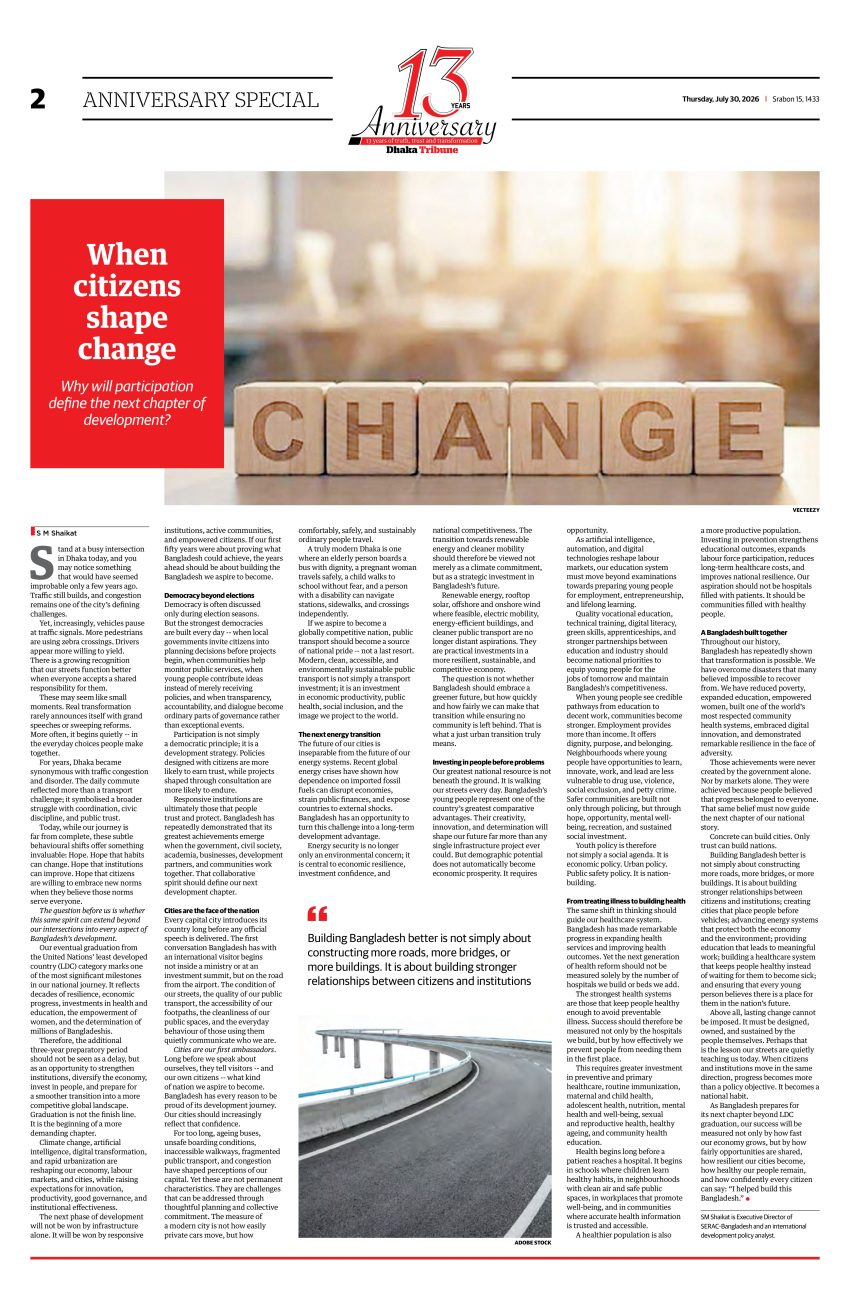
I am pleased to share my latest full-page op-ed, “When Citizens Shape Change: Why Participation Will Define the Next Chapter of Development,” published in the Dhaka Tribune’s 13th Anniversary Special Supplement under the theme “Building Bangladesh Better.”
The article reflects on why Bangladesh’s next chapter of development should be shaped not only by economic growth and infrastructure, but by stronger citizen participation, democracy, responsive institutions, resilient cities, quality education, preventive healthcare, youth empowerment, and a just transition towards a sustainable future.
The image below features the original e-newspaper publication as it appeared in the Dhaka Tribune.
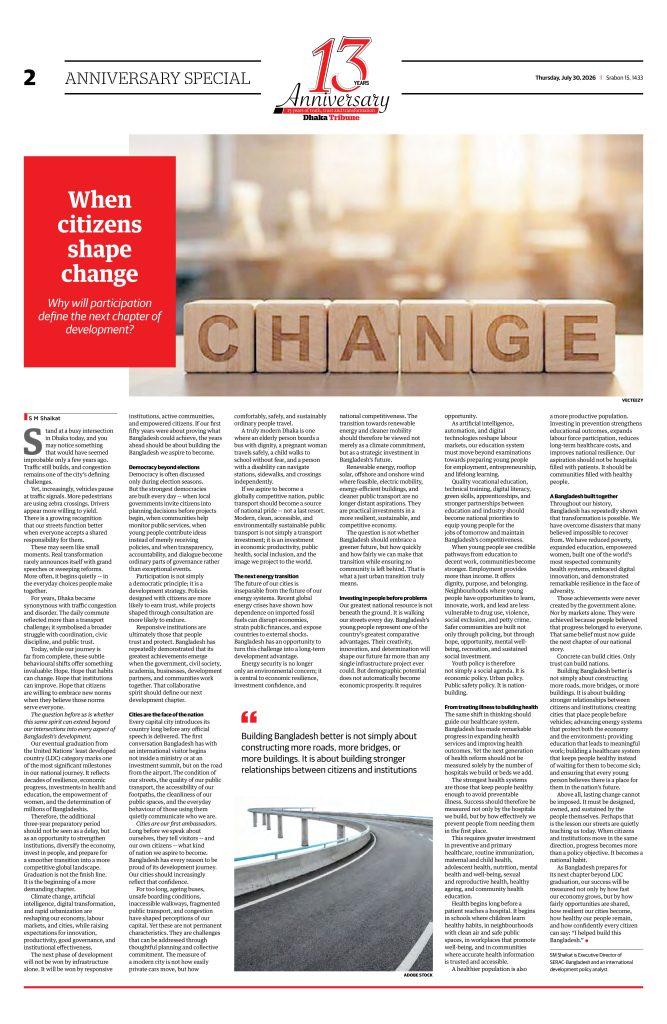
For readers who prefer a web-friendly format, the complete text of the article is reproduced below. A downloadable PDF version of the original published page is also available at the bottom of this page for those who wish to read or archive the article in its original newspaper layout.
—————————————————————————————————-
Stand at a busy intersection in Dhaka today, and you may notice something that would have seemed improbable only a few years ago. Traffic still builds, and congestion remains one of the city’s defining challenges. Yet, increasingly, vehicles pause at traffic signals. More pedestrians are using zebra crossings. Drivers appear more willing to yield. There is a growing recognition that our streets function better when everyone accepts a shared responsibility for them.
These may seem like small moments. Real transformation rarely announces itself with grand speeches or sweeping reforms. More often, it begins quietly- in the everyday choices people make together. For years, Dhaka became synonymous with traffic congestion and disorder. The daily commute reflected more than a transport challenge; it symbolised a broader struggle with coordination, civic discipline, and public trust. Today, while our journey is far from complete, these subtle behavioural shifts offer something invaluable: hope. Hope that habits can change. Hope that institutions can improve. Hope that citizens are willing to embrace new norms when they believe those norms serve everyone.
The question before us is whether this same spirit can extend beyond our intersections into every aspect of Bangladesh’s development.
Our graduation from the United Nations’ Least Developed Country (LDC) category marks one of the most significant milestones in our national journey. It reflects decades of resilience, economic progress, investments in health and education, the empowerment of women, and the determination of millions of Bangladeshis. Therefore, the additional three-year preparatory period should not be seen as a delay, but as an opportunity to strengthen institutions, diversify the economy, invest in people, and prepare for a smoother transition into a more competitive global landscape. Graduation is not the finish line. It is the beginning of a more demanding chapter.
Climate change, artificial intelligence, digital transformation, and rapid urbanisation are reshaping our economy, labour markets, and cities, while raising expectations for innovation, productivity, good governance, and institutional effectiveness. The next phase of development will not be won by infrastructure alone. It will be won by responsive institutions, active communities, and empowered citizens. If our first fifty years were about proving what Bangladesh could achieve, the years ahead should be about building the Bangladesh we aspire to become.
Democracy beyond elections
Democracy is often discussed only during election seasons. But the strongest democracies are built every day- when local governments invite citizens into planning decisions before projects begin, when communities help monitor public services, when young people contribute ideas instead of merely receiving policies, and when transparency, accountability, and dialogue become ordinary parts of governance rather than exceptional events.
Participation is not simply a democratic principle; it is a development strategy. Policies designed with citizens are more likely to earn trust, while projects shaped through consultation are more likely to endure. Responsive institutions are ultimately those that people trust and protect. Bangladesh has repeatedly demonstrated that its greatest achievements emerge when the government, civil society, academia, businesses, development partners, and communities work together. That collaborative spirit should define our next development chapter.
Cities are the face of the nation
Every capital city introduces its country long before any official speech is delivered. The first conversation Bangladesh has with an international visitor begins not inside a ministry or at an investment summit, but on the road from the airport. The condition of our streets, the quality of our public transport, the accessibility of our footpaths, the cleanliness of our public spaces, and the everyday behaviour of those using them quietly communicate who we are.
Cities are our first ambassadors. Long before we speak about ourselves, they tell visitors- and our own citizens- what kind of nation we aspire to become. Bangladesh has every reason to be proud of its development journey. Our cities should increasingly reflect that confidence.
For too long, ageing buses, unsafe boarding conditions, inaccessible walkways, fragmented public transport, and congestion have shaped perceptions of our capital. Yet these are not permanent characteristics. They are challenges that can be addressed through thoughtful planning and collective commitment. The measure of a modern city is not how easily private cars move, but how comfortably, safely, and sustainably ordinary people travel. A truly modern Dhaka is one where an elderly person boards a bus with dignity, a pregnant woman travels safely, a child walks to school without fear, and a person with a disability can navigate stations, sidewalks, and crossings independently. If we aspire to become a globally competitive nation, public transport should become a source of national pride- not a last resort. Modern, clean, accessible, and environmentally sustainable public transport is not simply a transport investment; it is an investment in economic productivity, public health, social inclusion, and the image we project to the world.
The next energy transition
The future of our cities is inseparable from the future of our energy systems. Recent global energy crises have shown how dependence on imported fossil fuels can disrupt economies, strain public finances, and expose countries to external shocks. Bangladesh has an opportunity to turn this challenge into a long-term development advantage.
Energy security is no longer only an environmental concern; it is central to economic resilience, investment confidence, and national competitiveness. The transition towards renewable energy and cleaner mobility should therefore be viewed not merely as a climate commitment, but as a strategic investment in Bangladesh’s future. Renewable energy, rooftop solar, offshore and onshore wind where feasible, electric mobility, energy-efficient buildings, and cleaner public transport are no longer distant aspirations. They are practical investments in a more resilient, sustainable, and competitive economy.
The question is not whether Bangladesh should embrace a greener future, but how quickly and how fairly we can make that transition while ensuring no community is left behind. That is what a just urban transition truly means.
Investing in people before problems
Our greatest national resource is not beneath the ground. It is walking our streets every day. Bangladesh’s young people represent one of the country’s greatest comparative advantages. Their creativity, innovation, and determination will shape our future far more than any single infrastructure project ever could. But demographic potential does not automatically become economic prosperity. It requires opportunity.
As artificial intelligence, automation, and digital technologies reshape labour markets, our education system must move beyond examinations towards preparing young people for employment, entrepreneurship, and lifelong learning. Quality vocational education, technical training, digital literacy, green skills, apprenticeships, and stronger partnerships between education and industry should become national priorities to equip young people for the jobs of tomorrow and maintain Bangladesh’s competitiveness. When young people see credible pathways from education to decent work, communities become stronger. Employment provides more than income. It offers dignity, purpose, and belonging. Neighbourhoods where young people have opportunities to learn, innovate, work, and lead are less vulnerable to drug use, violence, social exclusion, and petty crime. Safer communities are built not only through policing, but through hope, opportunity, mental well-being, recreation, and sustained social investment.
Youth policy is therefore not simply a social agenda. It is economic policy. Urban policy. Public safety policy. It is nation-building.
From treating illness to building health
The same shift in thinking should guide our healthcare system. Bangladesh has made remarkable progress in expanding health services and improving health outcomes. Yet the next generation of health reform should not be measured solely by the number of hospitals we build or beds we add.
The strongest health systems are those that keep people healthy enough to avoid preventable illness. Success should therefore be measured not only by the hospitals we build, but by how effectively we prevent people from needing them in the first place. This requires greater investment in preventive and primary healthcare, routine immunisation, maternal and child health, adolescent health, nutrition, mental health and well-being, sexual and reproductive health, healthy ageing, and community health education.
Health begins long before a patient reaches a hospital. It begins in schools where children learn healthy habits, in neighbourhoods with clean air and safe public spaces, in workplaces that promote well-being, and in communities where accurate health information is trusted and accessible. A healthier population is also a more productive population. Investing in prevention strengthens educational outcomes, expands labour force participation, reduces long-term healthcare costs, and improves national resilience. Our aspiration should not be hospitals filled with patients. It should be communities filled with healthy people.
A Bangladesh Built Together
Throughout our history, Bangladesh has repeatedly shown that transformation is possible. We have overcome disasters that many believed impossible to recover from. We have reduced poverty, expanded education, empowered women, built one of the world’s most respected community health systems, embraced digital innovation, and demonstrated remarkable resilience in the face of adversity.
Those achievements were never created by the government alone. Nor by markets alone. They were achieved because people believed that progress belonged to everyone. That same belief must now guide the next chapter of our national story.
Concrete can build cities. Only trust can build nations.
Building Bangladesh better is not simply about constructing more roads, more bridges, or more buildings. It is about building stronger relationships between citizens and institutions; creating cities that place people before vehicles; advancing energy systems that protect both the economy and the environment; providing education that leads to meaningful work; building a healthcare system that keeps people healthy instead of waiting for them to become sick; and ensuring that every young person believes there is a place for them in the nation’s future.
Above all, lasting change cannot be imposed. It must be designed, owned, and sustained by the people themselves. Perhaps that is the lesson our streets are quietly teaching us today. When citizens and institutions move in the same direction, progress becomes more than a policy objective. It becomes a national habit.
As Bangladesh prepares for its next chapter beyond LDC graduation, our success will be measured not only by how fast our economy grows, but by how fairly opportunities are shared, how resilient our cities become, how healthy our people remain, and how confidently every citizen can say: “I helped build this Bangladesh.” Because the strongest nations are not built only by governments. They are built by citizens who believe they belong to the future they are helping create.
SM Shaikat is Executive Director of SERAC-Bangladesh and an international development policy analyst.