
Published in Dhaka Tribune on October 8, 2026
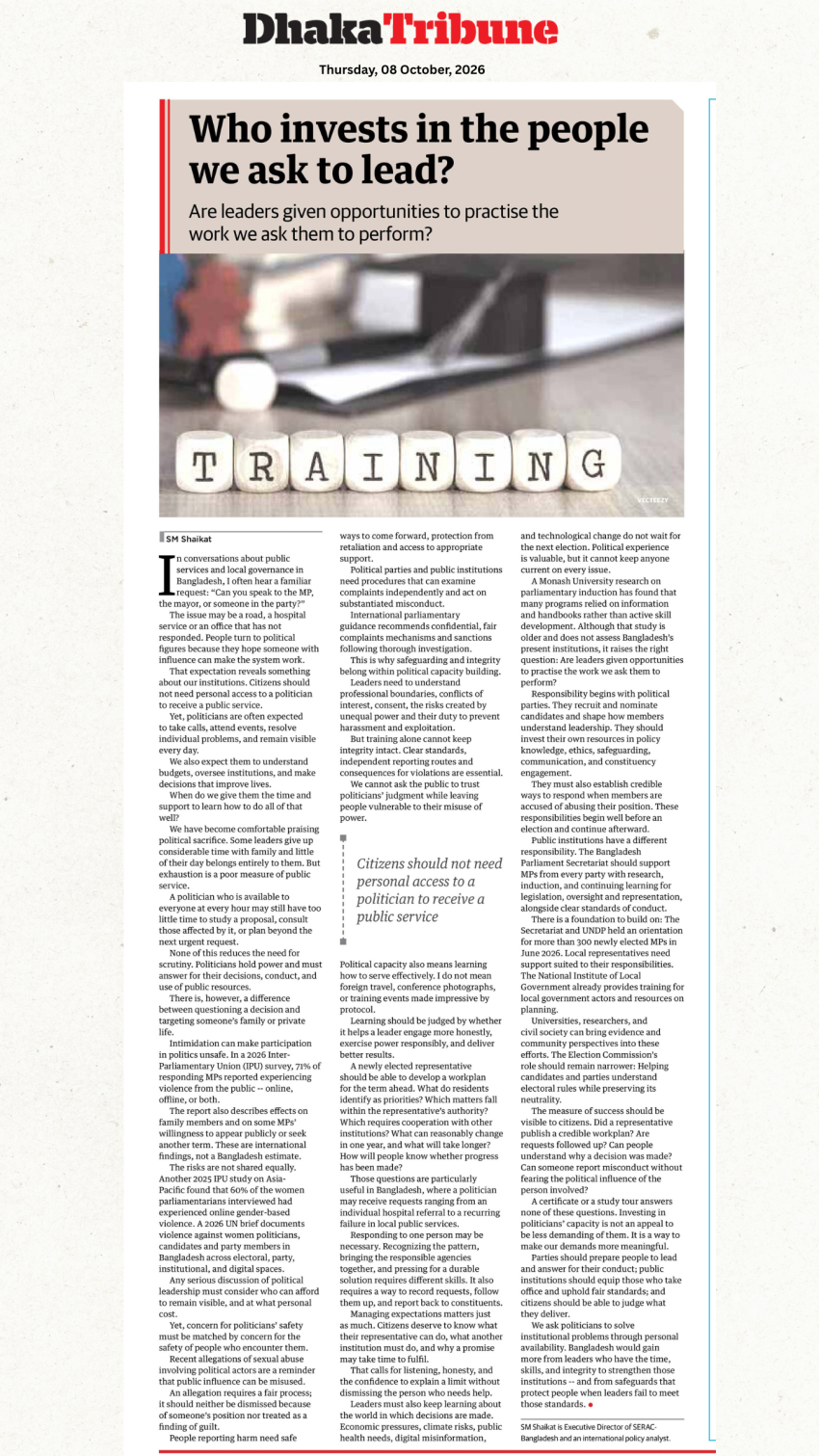
I’m happy to share my latest op-ed, ‘Who Invests in the People We Ask to Lead?’, in the Dhaka Tribune. We expect politicians to remain accessible, respond to community needs and make decisions that improve people’s lives. Yet we rarely ask how they find the time and support to develop the knowledge, skills and judgment these responsibilities demand.
Drawing on my experience in civic engagement and local governance in Bangladesh, the article explores how practical learning can help political leaders move from responding to individual requests towards strengthening the institutions responsible for public services. It considers constituency planning, communication, evidence use and the ability to keep pace with economic, technological and global changes.
The discussion also connects leaders’ well-being with their responsibility to protect others. Safeguarding, integrity and credible processes for addressing misconduct must accompany any investment in political capacity. Supporting leaders and holding them accountable are responsibilities that belong together.
This article demonstrates how political parties, the Parliament Secretariat, local government bodies, universities, and civil society can contribute. It contends that success should be measured by public service rather than certificates, conferences, or study tours.
Read the original article in Dhaka Tribune: https://www.dhakatribune.com/opinion/op-ed/421574/who-invests-in-the-people-we-ask-to-lead
Readers who prefer to read it here can find the complete article reproduced below.
“In conversations about public services and local governance in Bangladesh, I often hear a familiar request: “Can you speak to the MP, the mayor or someone in the party?” The issue may be a road, a hospital service or an office that has not responded. People turn to political figures because they hope someone with influence can make the system work.
That expectation reveals something about our institutions. Citizens should not need personal access to a politician to receive a public service. Yet politicians are often expected to take calls, attend events, resolve individual problems and remain visible every day. We also expect them to understand budgets, oversee institutions and make decisions that improve lives. When do we give them the time and support to learn how to do all of that well?
We have become comfortable praising political sacrifice. Some leaders give up considerable time with family and little of their day belongs entirely to them. But exhaustion is a poor measure of public service. A politician who is available to everyone at every hour may still have too little time to study a proposal, consult those affected by it or plan beyond the next urgent request.
None of this reduces the need for scrutiny. Politicians hold power and must answer for their decisions, conduct and use of public resources. There is, however, a difference between questioning a decision and targeting someone’s family or private life. Intimidation can make participation in politics unsafe. In a 2026 Inter-Parliamentary Union (IPU) survey, 71 percent of responding MPs reported experiencing violence from the public, online, offline or both. The report also describes effects on family members and on some MPs’ willingness to appear publicly or seek another term. These are international findings, not a Bangladesh estimate.
The risks are not shared equally. Another 2025 IPU study on Asia-Pacific found that 60 percent of the women parliamentarians interviewed had experienced online gender-based violence. A 2026 UN brief documents violence against women politicians, candidates and party members in Bangladesh across electoral, party, institutional and digital spaces. Any serious discussion of political leadership must consider who can afford to remain visible, and at what personal cost.
Yet concern for politicians’ safety must be matched by concern for the safety of people who encounter them. Recent allegations of sexual abuse involving political actors are a reminder that public influence can be misused. An allegation requires a fair process; it should neither be dismissed because of someone’s position nor treated as a finding of guilt. People reporting harm need safe ways to come forward, protection from retaliation and access to appropriate support. Political parties and public institutions need procedures that can examine complaints independently and act on substantiated misconduct. International parliamentary guidance recommends confidential, fair complaints mechanisms and sanctions following thorough investigation.
This is why safeguarding and integrity belong within political capacity building. Leaders need to understand professional boundaries, conflicts of interest, consent, the risks created by unequal power and their duty to prevent harassment and exploitation. But training alone cannot keep integrity intact. Clear standards, independent reporting routes and consequences for violations are essential. We cannot ask the public to trust politicians’ judgment while leaving people vulnerable to their misuse of power.
Political capacity also means learning how to serve effectively. I do not mean foreign travel, conference photographs or training events made impressive by protocol. Learning should be judged by whether it helps a leader engage more honestly, exercise power responsibly and deliver better results. A newly elected representative should be able to develop a workplan for the term ahead. What do residents identify as priorities? Which matters fall within the representative’s authority? Which requires cooperation with other institutions? What can reasonably change in one year, and what will take longer? How will people know whether progress has been made?
Those questions are particularly useful in Bangladesh, where a politician may receive requests ranging from an individual hospital referral to a recurring failure in local public services. Responding to one person may be necessary. Recognising the pattern, bringing the responsible agencies together and pressing for a durable solution requires different skills. It also requires a way to record requests, follow them up and report back to constituents.
Managing expectations matters just as much. Citizens deserve to know what their representative can do, what another institution must do and why a promise may take time to fulfil. That calls for listening, honesty and the confidence to explain a limit without dismissing the person who needs help. Leaders must also keep learning about the world in which decisions are made. Economic pressures, climate risks, public health needs, digital misinformation and technological change do not wait for the next election. Political experience is valuable, but it cannot keep anyone current on every issue. A Monash University research on parliamentary induction has found that many programmes relied on information and handbooks rather than active skill development. Although that study is older and does not assess Bangladesh’s present institutions, it raises the right question: are leaders given opportunities to practise the work we ask them to perform?
Responsibility begins with political parties. They recruit and nominate candidates and shape how members understand leadership. They should invest their own resources in policy knowledge, ethics, safeguarding, communication and constituency engagement. They must also establish credible ways to respond when members are accused of abusing their position. These responsibilities begin well before an election and continue afterward.
Public institutions have a different responsibility. The Bangladesh Parliament Secretariat should support MPs from every party with research, induction and continuing learning for legislation, oversight and representation, alongside clear standards of conduct. There is a foundation to build on: the Secretariat and UNDP held an orientation for more than 300 newly elected MPs in June 2026, and Parliament’s library supports members’ work. Local representatives need support suited to their responsibilities. The National Institute of Local Government already provides training for local government actors and resources on planning. Universities, researchers and civil society can bring evidence and community perspectives into these efforts. The Election Commission’s role should remain narrower: helping candidates and parties understand electoral rules while preserving its neutrality.
The measure of success should be visible to citizens. Did a representative publish a credible workplan? Are requests followed up? Can people understand why a decision was made? Can someone report misconduct without fearing the political influence of the person involved? A certificate or a study tour answers none of these questions. Investing in politicians’ capacity is not an appeal to be less demanding of them. It is a way to make our demands more meaningful. Parties should prepare people to lead and answer for their conduct; public institutions should equip those who take office and uphold fair standards; and citizens should be able to judge what they deliver. We ask politicians to solve institutional problems through personal availability. Bangladesh would gain more from leaders who have the time, skills and integrity to strengthen those institutions- and from safeguards that protect people when leaders fail to meet those standards.”
SM Shaikat is an international policy analyst working on civic participation, democratic governance and inclusive public leadership.